
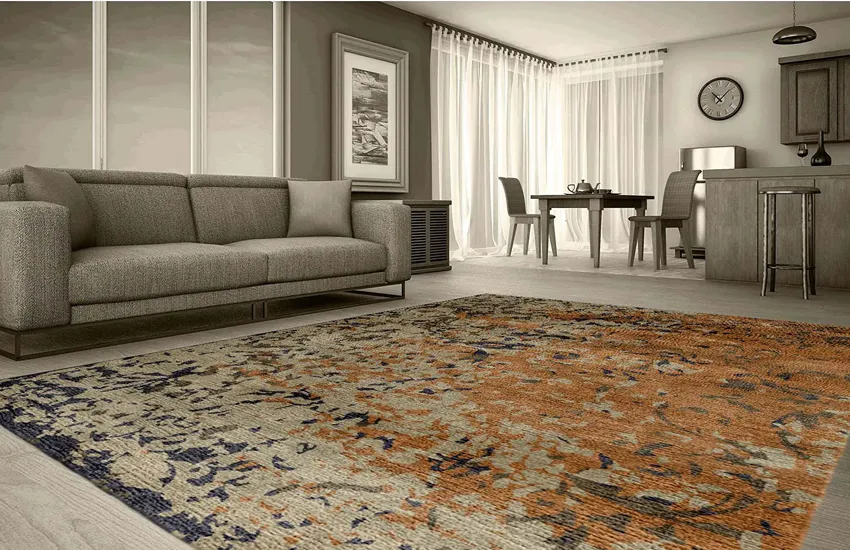
Layering rugs is one of the most effective styling moves you can make in a Dubai interior. A smaller, patterned or textured rug placed over a larger neutral base adds depth, softens hard tile and marble floors, and lets you introduce a bold design without committing the entire floor to it. This guide covers the rules that make layering work — which rug goes underneath, which goes on top, how to stop the top rug from sliding on tile, and which combinations suit each room in a Dubai home.
1. Why Layer Rugs?
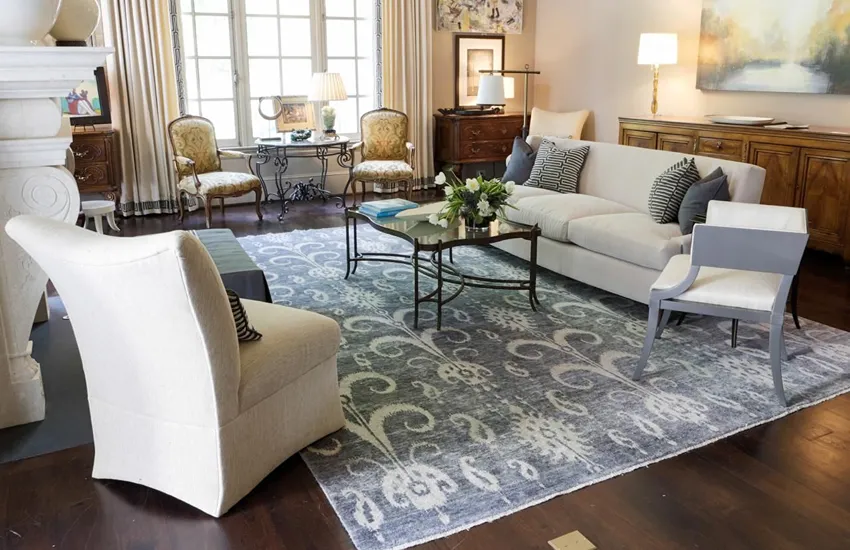
Layering adds depth, texture, and flexibility that a single rug cannot achieve on its own. In a Dubai home where the floor is typically polished marble or tile, a single rug can look like a small island on a hard sea. A larger neutral base rug frames a smaller, premium top rug, anchoring the arrangement and making it feel intentional.
The practical benefit is cost. A large jute or sisal base rug covers floor area at a lower cost per square metre than a premium patterned rug of the same size. The smaller top rug — a Persian, a handmade design, or a sentimental piece — delivers the visual impact. You get the coverage of a large rug and the beauty of a premium one, often for less than the cost of a single large premium rug. Layering also lets you swap the top rug seasonally without replacing the base.
2. The Five Rules of Rug Layering
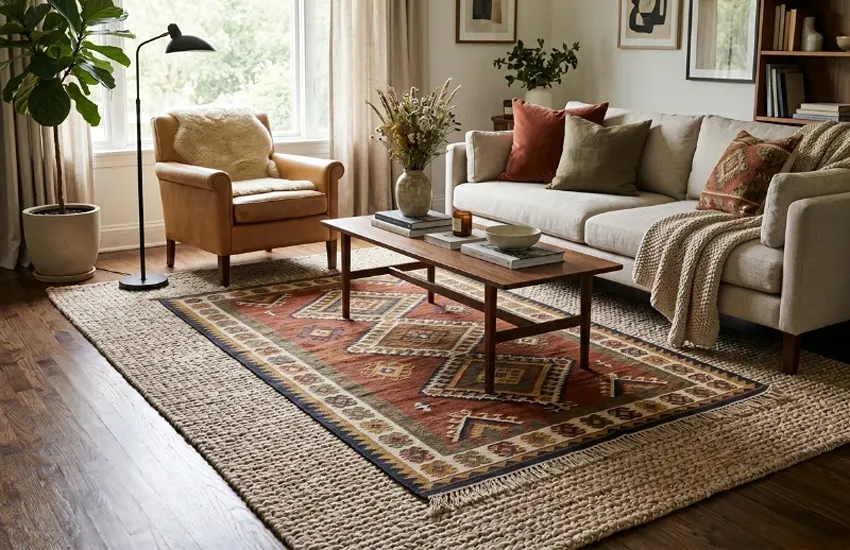
Rule 1 — The base rug is always larger.
The base should extend at least 30 to 60 cm beyond the top rug on all sides. If the base is only marginally larger, the layering looks accidental. The base rug’s job is to frame the top rug, and a frame needs to be visible.
Rule 2 — The base rug is neutral and low-pile.
A solid jute, sisal, flat-weave wool, or low-pile neutral works as a base. A patterned base competes with the top rug; a shaggy base makes the top rug sit unevenly. The base is the stage; the top rug is the performer.
Rule 3 — The top rug is the statement.
The top rug carries the pattern, colour, or texture. A Persian rug, a handmade design, or a boldly coloured piece works here. The top rug should be 60 to 90 cm smaller than the base in both dimensions.
Rule 4 — Textures contrast, not clash.
A flat jute base under a thick wool Persian is a contrast that works — smooth under rough. A shaggy base under a shaggy top is a clash — too much texture, no definition. Aim for one smooth surface framing one textured surface.
Rule 5 — The top rug must not slide.
On Dubai’s polished marble and tile, a sliding rug is a safety hazard. A non-slip mesh pad between the top rug and the base rug is essential. Without it, the top rug will creep within hours.
3. Which Rug Goes Where?
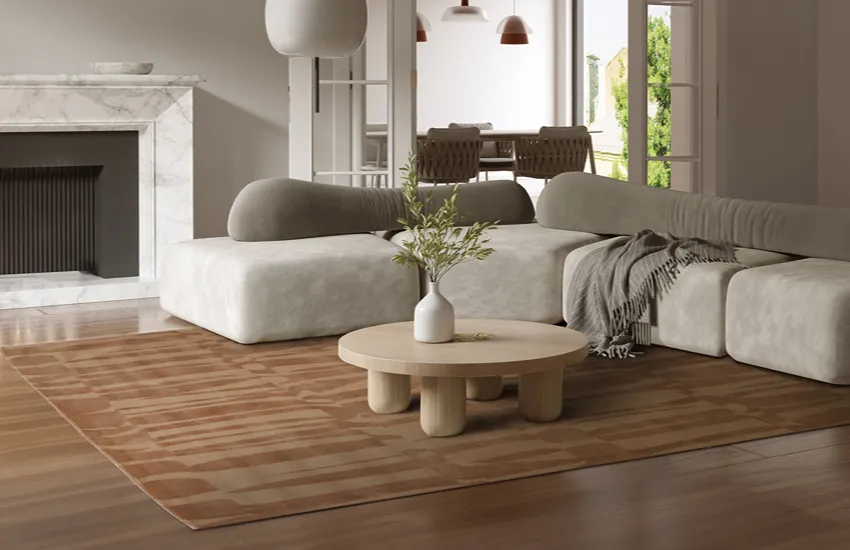
The table below summarises the most successful layering combinations for Dubai interiors. Use it as a starting point, then adjust for your room’s colour scheme.
| Base rug (underneath) | Top rug (on top) | Best room | Why it works |
|---|---|---|---|
| Jute or sisal, natural | Persian, patterned | Living room | Natural texture frames the pattern; warmth without weight |
| Flat-weave wool, cream | Handmade, geometric | Living room, study | Smooth base shows the geometric design cleanly |
| Low-pile wool, neutral | Shaggy, textured | Bedroom bedside | Firm base supports the shaggy top; cosy underfoot |
| Cotton flat-weave, beige | Round, patterned | Living room, nursery | Round over rectangular breaks the room’s linearity |
| Sisal, large | Animal skin or hide | Study, office | Organic shape over structured weave; grounded look |
The most popular combination in Dubai is a natural jute or sisal base under a Persian or handmade top rug. Browse the handmade rugs and Persian rugs ranges for top-rug options, and the shop for base-rug candidates.
4. Sizing: Getting the Proportions Right

Sizing is where most layering arrangements go wrong. The base rug needs to be large enough to anchor the furniture, and the top rug needs to be small enough that a visible frame of base rug shows on all sides.
- Base rug: Follow standard sizing rules — large enough that at least the front legs of the sofa sit on it in a living room, or extends 45 cm beyond the bed in a bedroom. For a typical Dubai living room (4 by 5 metres), a base rug of 300 by 400 cm is usually right.
- Top rug: Should be 60 to 90 cm smaller than the base in both dimensions, so a 30 to 45 cm frame of base rug shows on each side. For a 300 by 400 cm base, a top rug of roughly 200 by 300 cm works. If the top rug is too close in size to the base, the frame disappears and the layering looks like a mistake.
- Round over rectangular: A round rug of 150 to 200 cm diameter over a 250 by 350 cm rectangular base works beautifully under a coffee table. The round shape softens the geometry of the room and draws the eye to the centre of the seating area.
5. How to Stop the Top Rug Sliding on Tile
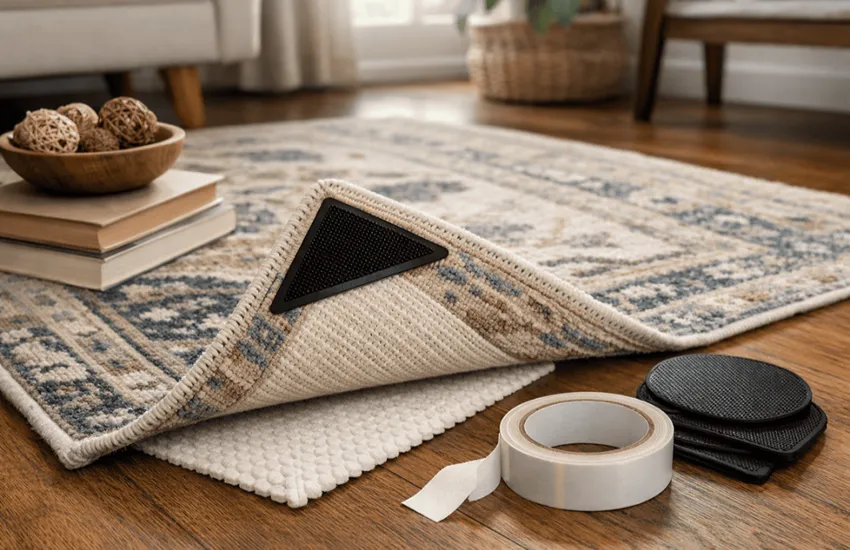
On Dubai’s polished marble and tile, both rugs need securing — the base rug on the floor, and the top rug on the base. A standard rug pad under the base rug stops it creeping on the floor. A thinner non-slip mesh pad, cut about 5 cm smaller than the top rug, goes between the two rugs. This second pad is the one most people forget, and it is the one that makes the biggest difference.
If you are layering a heavy rug (a thick wool Persian) over a flat base, the weight may hold it in place. Test for a day: place the top rug, walk on it, check if it has moved by evening. If it has shifted even a few centimetres, add the mesh pad.
6. Where Layering Works Best
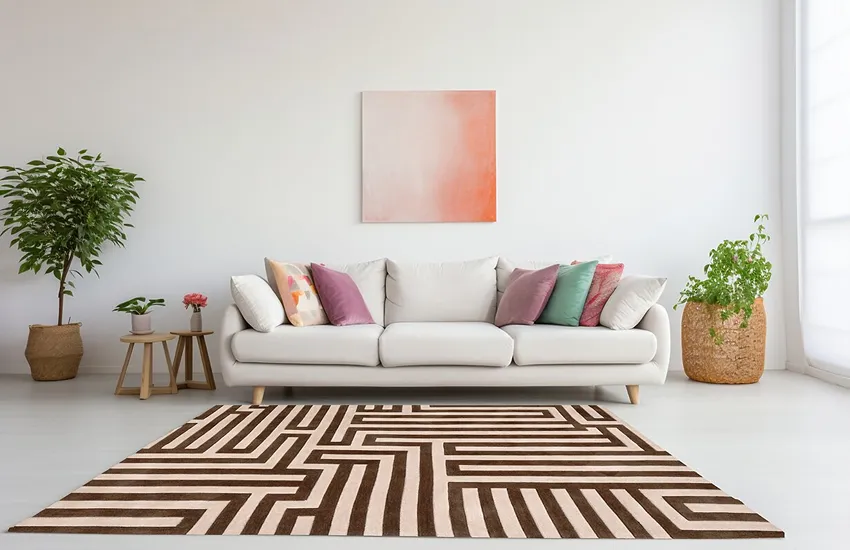
Living room: The natural home of rug layering. A large jute or flat-weave base anchors the seating, and a smaller Persian or handmade rug on top defines the coffee-table zone. This is the combination we recommend most often.
Bedroom: Layering works at the bedside. A large neutral base runs under the bed, and a smaller, softer rug — a shaggy rug or plush wool — sits on top where bare feet land first thing in the morning.
Dining room: Avoid layering here. Chairs catch on the lip between the two rugs and wobble. Use a single, low-pile rug that extends past the pulled-out chairs.
7. Dubai-Specific Layering Tips
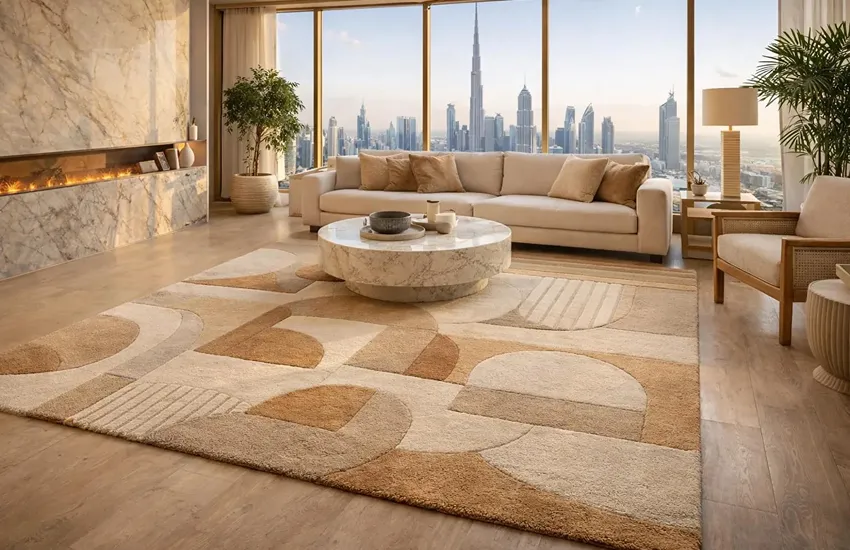
Sand settles between the layers. Fine Dubai sand works its way between the base and top rug, invisible until you lift the top. Every two to three months, lift the top rug, vacuum the base, and shake the top separately. Ten minutes of maintenance prevents abrasive sand from damaging both rugs.
AC-cooled rooms mean cold tile underneath. Layering is often about covering cold tile with something warm. A thicker base rug (low-pile wool rather than thin flat-weave) adds thermal comfort, and the top rug adds the visual layer. The combined effect is noticeably warmer than a single thin rug on bare tile.
Humidity affects natural-fibre bases. If the room is not continuously AC-cooled, choose a wool or synthetic base instead of jute.
Quick Reference — Layering Rugs in Dubai
- Base rug: Neutral, low-pile, 30-60 cm larger than the top on all sides. Jute, sisal, or flat-weave wool.
- Top rug: Patterned or textured, 60-90 cm smaller than the base. Persian, handmade, or shaggy.
- Non-slip pads: One under the base rug, one between the two rugs. Both essential on tile and marble.
- Avoid: Patterned base rugs, shaggy base rugs, layering under a dining table.
8. Next Steps: From Reading This Guide to a Layered Look

If you have read this far, you know the rules, the combinations, and the Dubai-specific maintenance that makes rug layering work. The fastest way to bring the look to life is to start with the right base rug and choose a top rug that contrasts in texture and pattern.
Step 1 — Decide your combination.
Use the matrix in Section 3. The most reliable starting point is a natural jute base with a Persian or handmade top. For a custom-sized base cut to fit your room, explore our custom made rugs service.
Step 2 — Browse the ranges.
Browse the shop for base rugs, and the Persian, handmade, shaggy, and round ranges for top rugs.
Step 3 — Visit the showroom.
Rug layering is easier to get right when you can see and feel the rugs in person. Visit our showroom at Al Quoz, Showroom 33, Dubai, or call +971 55 472 2980 to book a free in-home consultation. We bring samples, help you choose the right combination, and arrange the non-slip pads. For more guides, browse our blogs or reach out through the contact page.
The right base rug, the right top rug, and a non-slip pad underneath — and your living room goes from a rug on a floor to a designed space.
